Slate Cleaning London
Learn About Terrific Slate Cleaning London.
- Slate floor cleaning consultants are available just for you.
- two decades years experience with cleaning Slate tile floors.
- Our trusted experts are here to help you with your Slate cleaning, get your quote now.
Slate Floor Cleaning
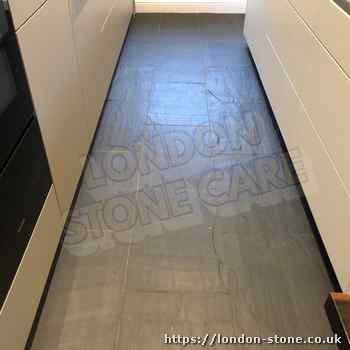
Cleaning Slate will get more challenging since the Slate becomes older. It is often a big headache figuring out what you should do. There are a number of businesses which claim to give great results, but how will you make a choice. The following is some essential information to help you make a good solution when looking for a trustworthy Slate floor restoration company.
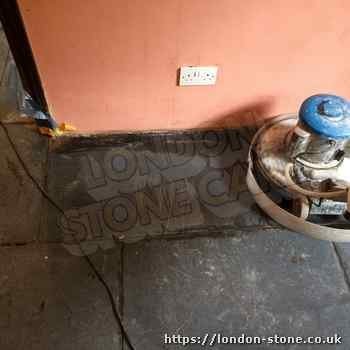
Slate is among the most widely used forms of natural stone, because it requires less maintenance and restoration work. Riven slate will get a build-up of dirt this is certainly difficult to get rid of. We use a rotary brushing machine and sealer removers to clean the slate. We then put on a lasting sealer which also makes the slate better to clean. Some slate floors can be ground to a smooth surface.
Slate Tile Cleaning
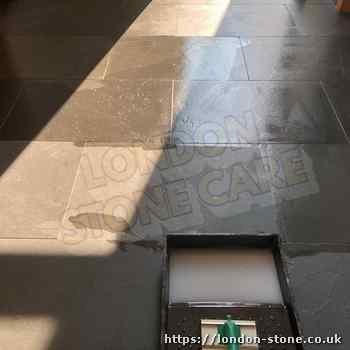
If homeowners keep on putting on coats of sealer and polish, with out getting rid of any older sealer, the effect is a heavy, unattractive coating.
When Slate has a heavy coat of old sealer, it really is difficult for a homeowner to remove it.
How professional Slate cleaning gets rid of the sealer residues and soil.
Strong Slate sealer removal and cleaning break up the sealer and impacted dirt.
After 20 minutes, the sealer remover and cleaner has softened the old sealer and ingrained dirt.
Rotary scrubbing helps lift the ingrained dirt off the stone.
Take off the cleaning slurry using clean water rinsing.
If there is lots of ingrained soil remaining, continue scrubing and rinsing until it is clean.
Smooth Slate is normally clean after 1 or 2 scrub and rinse steps.
But, with riven Slate, filled or unfilled, the cleaning might need to be repeated quite a few times.
After scrubbing and rinsing, deep nooks may still have soil.
The final phase with cleaning Slate tiles, is named hot rinse and extraction.
Pressurised heated water is pushed into the Slate cavities, expelling the ingrained dirt, that is completely vacuumed off.<.p>
It really is remarkable how much more soil this high-pressure rinsing process removes.
Cleaning and repairing Slate is called Slate restoration.
Slate Floor Repair
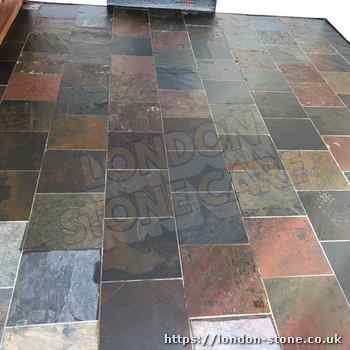
Slate tiles crack When not installed well or When there is sub-floor movement.
Cracks tend to be present in doorways and in between rooms.
Also, a crack can appear due to a deficiency or weak spot within the tile.
Repairing a crack costs less than lifting and replacing the tile.
Fine cracks in Slate can't accept a filling material.
We work by using fine diamond burrs, opening the crack to two to four mm depending on the form of the crack.
Then we fill the crack using a colour matched grout.
Grout could be left sponged or dry sanded.
It is difficult to create a repair invisible.
However a dirty crack is unattractive compared to a correct.
Slate Sealing
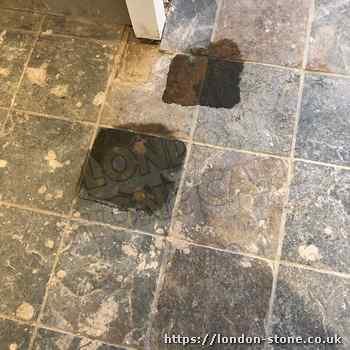
Bathrooms, kitchens and dining rooms have lots of fatty and water spills to mark Slate. Spills are able to pass through the top of tiles, giving unappealing stains. Top-notch Welsh Slate can easily mark, and imported varieties can vary dramatically in sbsorbancy. A stone sealer helps in avoiding a spill turning into a stain.
Contact Us Now!
Get a 100 % free Slate Cleaning London quotation now.Impregnating Or Penetrating Slate Sealer
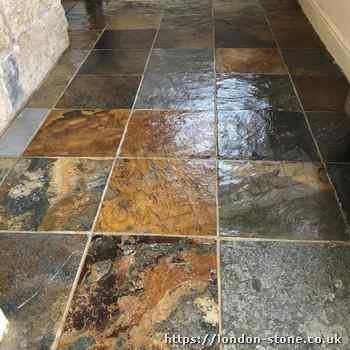
Slate can be sealed with an impregnating sealer, to protect and keep the natural look of a stone.
2 or 3 layers of sealer should really be enough for Slate.
The impregnating sealer should be topped up every year.
Bear in mind that an impregnating sealer does not protect against acid etching.
Topical Slate Sealers
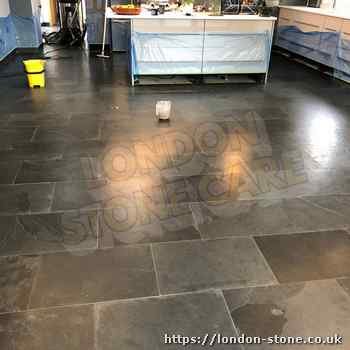
Surface sealers are also at your disposal for Slate.
Since, the sealer makes a protecting film over the surface of the floor tiles.
Acidic splatters induce less immediate damage to a surface sealer, but if the spill is not cleaned up, it may eventually penetrate the sealer and damage the Slate.
Surface sealers render extra protection to the Slate and grout.
A surface sealer used after an impregnating sealer gives better protection.
The impregnating sealer will help to protect the stone in areas where the original sealer starts to wear away.
You should expect a surface sealer to last 2 to 4 years.
We recommend evaluating traffic areas every few months for wear.
Deep clean traffic areas so they can be re-sealed.
Then top the location up with a couple of coats of sealer.
This advice is likely to make your sealer work for a lot longer.
{Also, you may not get an unattractive accumulation of sealer in areas that have minimal traffic. |And also this reduces ugly sealer build-up in edges and corners.|Also edges and corners will likely not experience an ugly build-up of old sealer.|By topping up where it really is required, {you will||you certainly will|you will definitely} preserve a good looking even coat of sealer.}
Slate Polishing
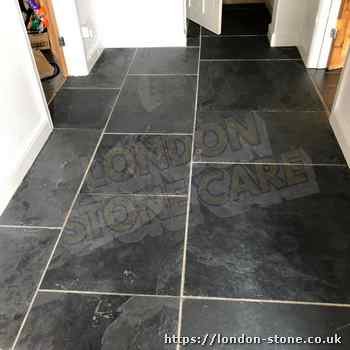
Slate Polishing is attained using a gloss surface sealer.
That said, a slate floor may also be ground and honed to a pleasing sheen.
It is not appropriate to hone riven or friable Slate. The natural flaking process keeps on going, messing up the look of the Slate floor.
Restore your Slate floors to help you appreciate them for decades to come.