
December 26, 2025 by
David Allen
Ceramic tiles are chosen because they’re durable, easy to live with, and designed to look consistent year after year. So when they start to look dull, patchy, or uneven, it’s understandable that it’s frustrating. Many homeowners worry they’ve damaged the tiles through cleaning, or that the surface itself has worn out. In reality, ceramic tiles behave very differently from how they appear when something goes wrong.
A professional looks at these situations calmly and methodically, separating what is happening on the surface from what is happening in the grout. The aim isn’t to jump to fixes, but to explain why the appearance has changed and what that usually means for restoring a clean, even finish.

In London, a specialist starts by examining how ceramic tiles are made and protected. The visible surface is a hard, fired coating designed to resist water, dirt, and staining. When tiles look tired, it’s rarely because the surface has failed, but because something is sitting on top of or around them, masking their original appearance through a non-porous surface.
Fila Pro Floor Cleaner | LTP MPG Sealer H20 | Vileda H2PrO Spin Mop System |
Professionally, it’s essential to set limits early. A dull or patchy look can’t be accurately diagnosed without seeing whether the problem sits on the tile surface, within the grout, or both. What can be said with confidence is that ceramic tiles themselves rarely wear out in everyday domestic use in London.
This is why experienced restorers focus first on understanding what’s changed visually, rather than assuming the tiles are damaged or beyond recovery.

This is one of the most common frustrations reported in London properties. Tiles can look perfectly clean when freshly mopped, only to dry with cloudy areas or uneven sheen. From a professional perspective, this pattern strongly suggests that something is drying on the surface rather than being absorbed, a characteristic of uneven drying.
Homeowners often notice that changing cleaners doesn’t resolve the problem, or that it shifts location rather than disappearing. That behaviour tells a specialist the issue is unlikely to be the tile body itself, but a layer of residue that redistributes with each clean.
A restorer would usually explain that this kind of patchiness is visual rather than structural, and that addressing it safely depends on identifying the residue rather than scrubbing harder.
In London households, routine cleaning products can leave behind invisible layers that build up over time. These layers dry unevenly, especially on larger tiled areas, creating dull patches and streaks that recur due to surface residue.
This is also where a clear professional boundary is needed. Cleaning can remove residues and contamination, but it cannot repair chemically damaged grout or reverse problems caused by aggressive past cleaning.
A specialist will often reassure homeowners that the protective coating on ceramic tiles is highly resilient. The factory-applied finish is designed to remain intact for decades. It does not absorb cleaners, water, or dirt under normal conditions, which is why issues are not attributed to the factory glaze.
This distinction matters because any attempt to abrade or “refresh” the tile surface would permanently damage that glaze, creating far bigger problems than dullness ever could.
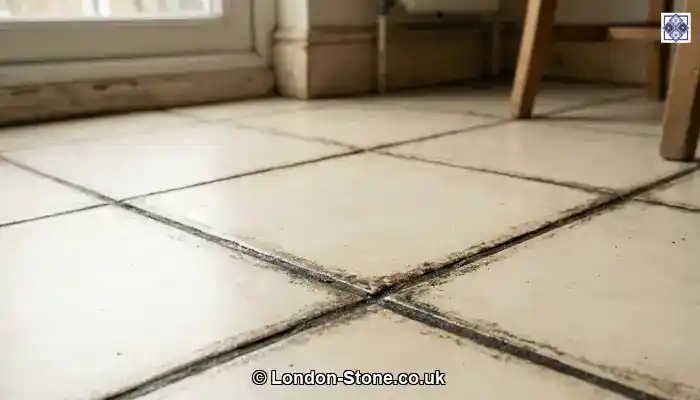
In many London homes, tiles look dirty even when the surface is relatively clean because the eye reads the floor as a whole. A professional pays close attention to the joints between tiles, knowing that discolouration there can dominate the overall appearance through grout discolouration.
This is especially relevant where homeowners feel they are constantly cleaning with little reward. The tiles may be clean, but the grout continues to darken, absorb residues, or react to cleaning products.
From a specialist’s point of view, this is one of the most common reasons ceramic floors look permanently tired.
Unlike tiles, grout is absorbent and vulnerable. In London kitchens, hallways, and bathrooms, it readily absorbs dirt, detergents, and moisture, gradually changing colour and texture due to porous grout.
It’s also important to be clear about limits. Cleaning can remove surface contamination, but it cannot undo chemical damage caused by bleaching, erosion, or stripping with unsuitable products.
Professionals often explain that grout acts like a frame around each tile. When that frame darkens or becomes uneven, it visually drags down the entire installation, regardless of how intact the tiles are, due to grout discolouration.
This is why restoring consistency in grout appearance can have a far greater impact than repeatedly cleaning the tile surface alone.
Another frequent cause of dullness in London homes is a persistent film that never quite disappears. A specialist recognises this as a layered problem, where residues from installation or cleaning interact and dry back unevenly as cleaning film.
These films can survive years of normal wear and often lead homeowners to believe the tiles are permanently marked.
Understanding the film’s origin is key before any corrective work is considered.
Grout residue left behind after installation can remain invisible for months, only becoming obvious as it attracts dirt and dulls the surface. In London properties, this is particularly common with modern grouts that bond tightly, leaving stubborn grout haze behind.
A professional would usually note that no amount of routine cleaning removes this type of residue once it has cured.
Many household cleaners are designed to leave a “fresh” finish, but over time, they deposit layers that attract dirt and dry patchily. Specialists often see floors that feel slightly sticky underfoot because of chemical residue.
This helps explain why changing brands rarely solves the issue, as the underlying build-up remains in place.
Textured finishes are popular in London homes for their slip resistance and visual interest, but they behave differently under cleaning. A restorer recognises that fine grooves and relief patterns naturally trap dirt, making textured tiles appear dull even when cleaned regularly.
This doesn’t indicate damage, but it does mean that regular mopping often fails to reach the areas where dirt is trapped.
Professionally, this is handled through careful cleaning approaches rather than aggressive abrasion.
One of the most critical professional explanations is setting realistic expectations. Cleaning is effective at removing surface dirt, films, and residues, but it has limits when it comes to structural or chemical changes, especially regarding surface residues.
In the first half of any assessment, a specialist is clear that ceramic tiles cannot be mechanically refinished. Any abrasive process would permanently damage the glazed surface, worsening the problem.
This clarity helps homeowners understand why repeated cleaning attempts don’t always deliver lasting improvement.
In London, homeowners are often advised to seal tiles to address dullness. A professional explains that this advice misunderstands how ceramic tiles work, as sealing a glazed surface rarely improves appearance and often worsens build-up through chemical residue.
Sealers are designed for absorbent materials, not factory-glazed tiles. When applied unnecessarily, they dry on the surface and attract dirt.
This is a key example of why assessment comes before any product is selected.
When dullness, patchiness, or haze keeps returning in a London home despite careful cleaning, a specialist would usually recommend stepping back to assess where the problem truly lies. This process focuses on separating tile surface issues from grout-related ones, rather than guessing at fixes, based on surface residue.
Results and longevity always depend on tile texture, grout condition, past products used, and how the area is maintained afterwards. These factors can’t be confirmed remotely, which is why professional judgement plays such a central role.
At this point, clarity often replaces frustration, and sensible next steps become much easier to define.
If you want clear, calm guidance on why your ceramic tiles look dull or blotchy, and what a professional would usually consider next, speaking with a specialist can help you understand your options without pressure.
Dull or patchy ceramic tiles are rarely a sign of failure. In most cases, they’re telling you something about residue, grout condition, or past cleaning habits rather than damage to the tiles themselves. Understanding those signals is the first step toward restoring a clean, even appearance.
A professional approach prioritises explanation, limits, and safe outcomes. By focusing on causes rather than quick fixes, homeowners can avoid unnecessary damage and wasted effort.
David Allen is a natural stone and tile restoration specialist with over 30 years of hands-on experience working in homes across the UK. His work focuses on diagnosing surface appearance issues, safely restoring ceramic and grout installations, and helping homeowners understand how to protect and maintain their floors with confidence.
Ceramic tiles are extremely durable, but their appearance can be affected by what sits on the surface or in the grout around them. Residues from cleaning products, grout haze, or discoloured grout often mask the original finish, making tiles look dull even though the tile itself is still sound.
This usually happens when a thin film of residue dries unevenly on the surface. While the tiles are wet, everything looks uniform, but as moisture evaporates, leftover cleaning film becomes visible, creating a patchy or cloudy appearance.
Yes. Grout has a strong visual impact on how a tiled floor or wall is perceived. Because grout is porous, it absorbs dirt and residues more easily than tiles. When grout darkens or becomes uneven in colour, it can make the entire installation look unclean, even if the tiles themselves are relatively clean.
In most cases, the tiles themselves are not damaged. However, repeated use of strong or unsuitable cleaners can leave residues behind or cause chemical damage to the grout. This is why appearance problems often persist despite frequent cleaning and why more aggressive scrubbing rarely helps.
If dullness, haze, or patchiness keeps returning despite careful cleaning, a professional assessment can help determine whether the issue lies on the tile surface, in the grout, or both. This clarity helps avoid unnecessary treatments and ensures any solution is appropriate for the condition of the tiles and grout.
David Allen is a guest contributor to London-Stone.co.uk and a highly experienced natural stone and tile restoration specialist with over 30 years of hands-on work in homes across the UK.
His professional focus is diagnosing why stone and tile floors look wrong even when they are structurally sound. Rather than relying on product claims or quick fixes, David’s approach centres on understanding surface behaviour, grout condition, residue build-up, and how everyday cleaning habits affect appearance over time.
In this article, David draws on decades of practical experience restoring ceramic tile and grout installations in London homes. He aims to help homeowners understand why ceramic tiles can appear dull, patchy, or uneven, and why aggressive cleaning or sealing often makes matters worse.
Known for his calm, methodical explanations, David specialises in setting realistic expectations, clearly explaining limits, and guiding homeowners towards safe, appropriate solutions that avoid unnecessary damage. His work prioritises long-term results, informed decision-making, and the preservation of floors rather than experimentation.
