Victorian Tile Restoration Cost Guide: London & Home Counties (2026)
January 23, 2026 by
David Allen
What You’re Really Deciding When You Search “Restoration Cost”
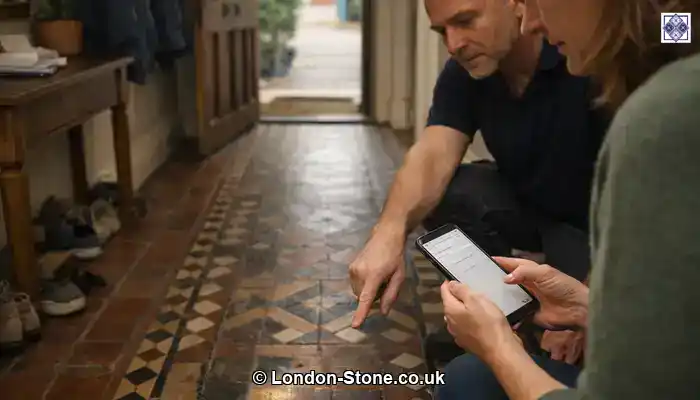
This guide breaks down the real-world costs of Victorian clay and encaustic tile restoration, providing a clear budgeting framework for homeowners. While the technical principles of heritage tile care remain consistent across the UK, pricing is heavily influenced by regional labor rates and local logistical challenges.
To provide the most accurate benchmarks, the figures in this guide are based on specialist day rates and project scopes typical of London and the Home Counties (Bedfordshire, Berkshire, Buckinghamshire, Essex, and Hertfordshire), the UK’s most concentrated areas for historic tile preservation. Whether you’ve searched for “restoration cost” to find a bargain or to ensure you’re hiring the right specialist, this guide explains what drives the price climb and how to avoid the hidden costs of paying for the same job twice.
If you’ve typed “Victorian tile restoration cost” into Google, you’re usually not hunting for a bargain. You’re trying to get your bearings: what this is likely to cost, what makes the price climb, and how to avoid paying twice.
2026 Costs At A Glance (London & Home Counties)

- Specialist Day Rate: £250–£650 (Factors include location, access, and specific expertise).
- Small Hallway (≤15 m²), Clean + Seal: £500–£1,300 (Typically a 2-day project).
- Significant Repairs: Often adds +£350–£650 (Usually adds 1 additional day).
- Subfloor Remediation: Major structural works can exceed £5,000 for full stabilization.
The choice is rarely “do I clean the floor or not?”. It’s normally:
- Is this a straightforward clean and seal, or is there hidden work under old coatings and adhesive?
- Is the floor stable enough to restore as it sits, or does it need repairs first?
- Can someone give me a useful ballpark from photos, and when does it need a visit or test area?
- How do I compare quotes without guessing what each one actually includes?
This guide is written to help you understand how a specialist prices work on old clay tiles across London, Bedfordshire, Berkshire, Buckinghamshire, Essex, and Hertfordshire, using real scope drivers and realistic limits.
Why Victorian Clay And Encaustic Tiles Don’t Price Like Modern Floors
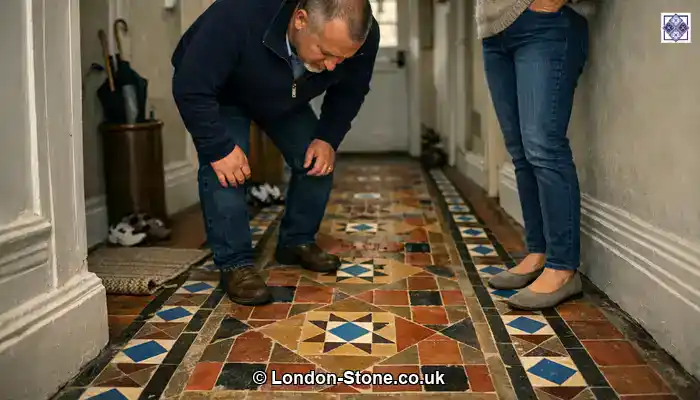
Victorian and encaustic tiles aren’t modern glazed ceramics. They’re typically unglazed, porous clay with oxide pigments, and many older floors were laid without a modern damp-proof membrane (DPM). That changes how cleaning, drying, and sealing need to be handled.
From a pricing point of view, two things matter immediately:
- What’s in the pores and on the surface (old waxes, degraded films, adhesive staining, ingrained soil).
- What’s happening underneath (whether the floor is moisture-active, whether tiles are loose, and whether joints or the bed are failing).
That’s why a Victorian floor can look “simple” on day one, then become a longer job once old coatings start lifting and you can see what the tiles and joints are actually doing.
What The Baseline Usually Covers: Clean, Minor Repairs, Then Seal

It helps to start with a baseline, because most cost confusion comes from comparing a basic clean-and-seal quote with a quote that quietly includes stripping, adhesive work, or stabilisation.
A typical baseline scope (when the floor is broadly sound) includes:
- Set-up and protection.
- Deep cleaning suited to porous clay tiles, with controlled rinsing and extraction (to avoid over-wetting the bed).
- Minor repairs where practical during the clean (small local fills, minor stabilisation, small joint touch-ups).
- Sealing, typically 2–4 coats, with roughly 30–60 minutes between coats depending on conditions.
That baseline does not include major stripping of thick coatings, heavy adhesive residue removal, widespread joint replacement, tile replacement, or subfloor remediation. Those are separate scope drivers, and they’re where costs move.
Typical Costs For Small Hallways (And The Assumptions Behind Them)
Many Victorian tile jobs are terraced hallways: small, awkward spaces where one person can work efficiently but two people often can’t. On jobs like that, specialists commonly price on a day rate because the work blocks the diary.
Day-rate range used here: £250–£650 per day. Where costs sit within that range is commonly influenced by logistics such as parking and access, which can be more challenging in parts of London and more straightforward in some areas of Bedfordshire, Berkshire, Buckinghamshire, Essex, and Hertfordshire.
| Scope | Typical Days | Typical Range | What Must Be True For That Range |
|---|---|---|---|
| Small hallway (≤15 m²): clean + seal (baseline) | 2 days | £500–£1,300 | Clean + seal only; no heavy layered coatings; no major adhesive/gripper work; no instability needing major repairs |
| Significant repairs on a small hallway | +1 day (often) | +£350–£650 | Repairs move beyond “minor”; grout work, tile repairs/replacement, or extra stabilisation is required |
| Subfloor failure / major works | Variable | Can exceed £5,000 | Evidence of lifting, dusting subfloor, or widespread movement requiring structural remediation, not just cleaning and sealing |
Typical small hallway baseline: up to ~15 m², planned as 2 days:
- Day 1: set-up, deep clean, and minor repairs where practical.
- Day 2: seal, usually 2–4 coats, allowing 30–60 minutes between coats.
Using the approved day-rate range, that baseline commonly lands at £500–£1,300 for a small hallway.
The key is the assumption. That range applies when the job really is “clean, minor repairs, then seal”. If thick coatings, gripper adhesive, salts, loose tiles, or failing joints are present, the duration (and therefore cost) can change.
What Makes Costs Jump: Old Sealers And Multiple Coating Layers
One of the biggest reasons a Victorian tile quote rises is old sealer build-up. People often think they have a “dirty floor”, when the real issue is multiple layers of failed coating trapping soil and breaking down unevenly.
When there are multiple layers of old sealer, removal can require:
- Multiple applications of sealer remover.
- Repeated agitation and extraction cycles.
- Hand detailing around edges and patterns.
In extreme cases the coating can be so thick it needs to be removed by hand scraping. Small tiles and worn, dished surfaces slow this down because residue sits in low spots and along edges, and aggressive abrasion is not an appropriate way to “speed things up” on heritage clay tiles.
As an example (not a promise), there are real jobs where a ~15 m² hallway took around 2 days to strip old sealer and clean the underlying tiles, including roughly 1.5 days of careful hand scraping because the coating was thick and the tiles were dished.
Pricing implication: heavy coating removal can add 1–2 extra days depending on thickness and layer count, and you can’t always confirm that from photos alone.
Carpet Gripper And Adhesive Residue: The Hidden Labour Most Quotes Have To Allow For
Carpet gripper is a common surprise on Victorian hallways. It’s not just the timber strip itself; it’s what’s underneath and what removal risks doing to the tiles.
Glue-Down Gripper
Glue-down gripper needs careful removal of the wood without dislodging tiles. Once the timber is up, adhesive residue often needs:
- Controlled application of adhesive remover.
- Dwell time (it has to be allowed to work).
- Hand scraping followed by pad scrubbing.
- Multiple applications where residue is thick or has penetrated.
This is slow, hand-led work. It can block a day simply because you’re waiting for dwell cycles and then lifting residue safely.
Nailed Or Screwed Gripper
Nailed or screwed gripper needs extreme care to remove while minimising tile damage. In practice, removing the fixings often causes some damage, so the holes typically need filling with a colour-matched filler such as cement, hard wax, or resin.
That filling can be blended, but it can’t be guaranteed invisible on worn historic tiles. It is, however, often the sensible compromise to stabilise and tidy a floor without turning the entire job into a full uplift.
Repairs That Commonly Add A Day: Grout Work, Tile Repairs, And Replacements
On small floors, significant repairs often add time in a very simple way: you can’t do two jobs at once in a tight hallway. If repairs move beyond “minor”, they commonly take a separate day.
Examples that frequently push a job beyond the baseline include:
- Grout cleaning and replacement.
- Tile repairs (chips/cracks) and localised filling.
- Tile replacement (especially where matching is limited).
- Localised subfloor rectification.
- Sourcing aged or new replacement tiles (if available), or making inserts where matching tiles are not available.
On smaller floors, that extra day commonly adds £350–£650 depending on location and what the work actually involves.
It’s also worth being realistic about blending: repairs can be made neat and sympathetic, but they may not disappear completely. That’s normal for historic tiles.
Moisture, Salts, And Drying Time: When Efflorescence Adds Risk Control
White salts (efflorescence) and patchy whitening can be symptoms of moisture moving through a porous floor. Many older Victorian installations are moisture-active because of how they were laid, and sealing choices must suit that reality.
From a cost point of view, moisture and salts matter because they change how a specialist controls the job:
- Over-wetting can mobilise salts and slow drying.
- Poor extraction can leave moisture in the bed, leading to patchy re-soiling or recurring salts.
- Sealing must be breathable on moisture-active floors to reduce the risk of whitening, blooming, or peeling.
This is also a limit worth stating plainly: sealing can improve resistance to absorption and day-to-day cleaning, but it cannot “stop damp” if the subfloor remains moisture-active. If salts are part of the picture, time can be spent on risk control rather than speed, and that affects cost.
Subfloor Problems And Major Works: When Costs Can Go Beyond £5,000
Most people asking about restoration cost are thinking about the tile surface. But when the subfloor is failing, the work stops being a finishing job and becomes a structural one.
Subfloor repairs can take many forms. Examples include:
- Hard lime beds that crack so sections lift and become unstable (sometimes needing local grinding/levelling where cracks create high points).
- Cement subfloors that fail to dust, where areas may need to be removed and refilled.
This is where costs can rise well above £5,000 and become major works. It’s also where honest conversations matter: in many cases, restoration becomes a compromise to achieve the best possible result within a budget.
One common example is extensive debonding, where tiles are only partially adhered or not adhered at all. Sometimes they remain in place mechanically, and a full uplift and re-bed isn’t practical within budget. In those cases, judicious grouting can reduce movement and stabilise the surface. It’s not the same as rebuilding the floor, but it can be a sensible stabilisation route when the alternative is a far larger project.
Larger Areas And Economies Of Scale: When Per-Metre Pricing Starts To Make Sense
Not all Victorian tile work is a tiny hallway. Larger areas can sometimes be completed surprisingly quickly when the condition is excellent and there are no legacy problems to strip away.
As an example (not a promise), there are real projects where a specialist cleaned and applied a colour-enhancing impregnating sealer to over 60 m² in two days because:
- The tiles were in excellent condition.
- They needed cleaning before sealing only.
- No repairs were required.
This is what “economies of scale” looks like in practice: set-up time and coat intervals are spread over a larger area, and the work is continuous rather than stop-start detailing. On floors over roughly 30 m², it may be possible to price per square metre, or use a hybrid approach, depending on layout and scope.
What A Proper Assessment Looks Like (And Why It Changes The Price)
The reason Victorian restoration pricing varies isn’t mystery pricing. It’s because the scope can’t be responsibly confirmed until you know what you’re dealing with: coatings, adhesives, salts, stability, and the condition of joints.
A proper assessment typically focuses on:
- What’s on the tiles (waxes, films, sealers) and how many layers are present.
- Whether there is adhesive staining or gripper residue to remove.
- Whether the floor is showing efflorescence or other moisture-linked symptoms.
- Whether tiles are loose, hollow, or moving, and whether joints are failing.
- What finish is appropriate for the floor’s moisture behaviour (breathable systems on moisture-active floors).
That assessment is what stops you paying for the wrong approach. It also explains why two quotes can differ: one may be pricing “clean and seal”, while the other is allowing time for stripping and stabilisation that they suspect is likely.
Ballpark Pricing From Photos: What We Need To Give You A Useful Range
Photographs can be a good guide for an experienced eye, and in many cases it’s possible to give a useful ballpark so you can decide whether the project is worth pursuing.
To give a meaningful range, a specialist typically needs a consistent photo set:
- Full hallway/room from both ends.
- Close-ups of dull/dark patches and traffic lanes.
- Edges, thresholds, and skirting lines.
- Any white salts or whitening patches.
- Any cracked, chipped, or loose tiles.
- Any remaining gripper or adhesive areas (if present).
The ballpark should always be stated with assumptions, for example: “This range assumes it’s a clean-and-seal with no heavy coatings and no instability.”
And it should always spell out what would change the price: extra days for thick sealer stripping, adhesive removal, repairs, drying time, or signs of movement. Final pricing is normally confirmed only after initial findings from a test area or an on-site assessment where the risks justify it.
DIY Versus Specialist Work: Where The Real Risks And Rework Costs Sit
It’s completely normal to wonder whether you can do part of this yourself, especially when you’re looking at day rates. The issue is that on Victorian clay tiles, the costly mistakes are usually irreversible.
The biggest DIY risk areas tend to be:
- Using harsh chemicals (or the wrong chemistry) and damaging pigments or leaving residues that interfere with sealing.
- Over-wetting and failing to extract properly, which can mobilise salts and slow drying.
- Using aggressive pads or scrubbers that abrade the tile face, especially on worn areas.
- Applying coatings without removing old films properly, leading to patchy finishes and rapid re-soiling.
A specialist approach is not “more aggressive cleaning”. It’s controlled stripping and extraction, moisture-aware drying, and using breathable sealing systems where the floor needs them. That’s why professional work can cost more up front but reduce the odds of paying again to undo a failed attempt.
How To Compare Quotes Fairly: Questions To Ask And Red Flags To Avoid
If you only compare a number at the bottom of the page, you’re guessing. The safer approach is to compare scope, assumptions, and risk controls.
Questions to ask any provider:
- Does your quote assume this is “clean and seal”, or are you allowing for old sealer stripping?
- How do you handle thick or multiple coating layers if they appear once work starts?
- What’s your approach to adhesive residue and carpet gripper removal?
- How do you control over-wetting and manage extraction on porous clay tiles?
- What would make the job take an extra day (and how would that be agreed)?
- If tiles are loose or hollow, what stabilisation is included and what is excluded?
- What sealer type is appropriate if the floor is moisture-active (and what finishes are not suitable)?
Red flags to watch for:
- Fixed, confident promises without any mention of coatings, moisture, salts, or stability.
- Quotes that don’t state assumptions or what could change scope once stripping begins.
- Any suggestion of “just acid wash it” as a general solution for Victorian clay tiles.
- High-shine coating promises on floors that may be moisture-active, without checking suitability.
What Results Are Realistic For Historic Tiles In London Homes
A good restoration improves clarity, colour depth, and day-to-day cleanability. It does not turn a 120-year-old floor into a new one.
Realistic expectations for Victorian clay and encaustic tiles:
- Dishing and wear in traffic lanes remain visible.
- Colour variation is inherent; some tiles will always look slightly different.
- Repairs can be blended, but they may not disappear completely.
- Where the floor is moisture-active, a breathable approach is used to reduce the risk of whitening and failure.
In other words: the character stays, but the floor becomes cleaner, richer, and easier to live with.
Maintenance After Restoration: What Protects The Result And What Undoes It
Maintenance is where the “value” of restoration is either preserved or slowly undone. The aim is simple: keep grit and harsh chemistry off a porous surface and avoid flooding it with water.
Good maintenance habits include:
- Vacuum or sweep regularly to remove abrasive grit.
- Use pH-neutral cleaning (no bleach, no acidic cleaners).
- Damp mop only; avoid over-wetting and do not flood the floor.
- Use entrance mats to reduce soil loading in hallways.
Over time, sealers wear. As protection reduces, floors become harder to clean and can start to dull. That’s usually the signal that re-sealing is due, rather than reaching for stronger cleaners.
Next Step If You Want A Meaningful Cost Answer For Your Floor
If you want a cost that actually helps you decide, the fastest route is a ballpark range based on clear photos and clear assumptions, followed by a test area or visit only where the risks justify it.
For a small hallway in baseline condition, a typical starting point is a two-day clean-and-seal planned on a day rate (often landing in the £500–£1,300 range). From there, costs move mainly when thick old sealers, adhesive/gripper residue, repairs, salts, or instability are present.
Request a calm, photo-led ballpark and scope check so you can decide whether it’s worth taking to the next step.
Frequently Asked Questions
Why is there such a wide price range for Victorian tile restoration?
Because the real cost is driven by scope, not just square metres. A “clean and seal” on a stable floor is usually predictable, but prices rise when there are thick old coatings to strip, carpet gripper glue to remove, salts to manage, or repairs needed to stabilise tiles and joints.
Can you give an accurate quote from photos alone?
Photos can often support a useful ballpark range, but final pricing can’t always be confirmed until coatings and residues are tested. Thick sealer build-up, adhesive contamination, salts, and tile movement don’t always show clearly in pictures.
What’s normally included in a basic “clean and seal” price?
Typically: set-up and protection, deep cleaning suited to porous clay tiles with controlled rinsing and extraction, minor repairs where practical during cleaning, then sealing (often 2–4 coats with coat intervals driven by conditions). It usually excludes major coating stripping, heavy adhesive removal, widespread grout replacement, tile replacement, or subfloor works.
What usually adds an extra day on a small hallway?
The most common time-drains are thick or multiple sealer layers, carpet gripper and adhesive residue, and repairs that move beyond “minor” (such as grout replacement, stabilisation, or tile repairs/replacements). In a tight hallway, that extra work often needs its own day.
If my floor has efflorescence, will sealing stop it coming back?
No. Sealing can improve resistance to everyday absorption and make cleaning easier, but it can’t “stop damp” if moisture is still moving through the subfloor. Where salts are present, the approach needs to be moisture-aware and breathable to reduce the risk of whitening, blooming, or peeling.
Author

Related Articles
No other posts in this category